Why a Lumbar Disc Is Like a Jelly Donut
(And Why That Matters When It Herniates)
If you’ve ever been told you have a “slipped disc” or a “herniated disc,” the language alone can sound alarming. Many people imagine something popping out of place or breaking entirely. In reality, what’s happening is much more subtle—and surprisingly easy to understand—once you picture your spinal disc as a jelly donut.
Between each of the bones in your spine (the vertebrae) sits a disc. These discs act as shock absorbers, allowing the spine to bend, twist, and move smoothly. Each disc has two main parts.
The outer layer is tough and fibrous, designed to contain pressure. The inner portion is softer and gel-like, built to absorb load and movement.
Put those together and you have… a jelly donut.
The Anatomy of the Donut
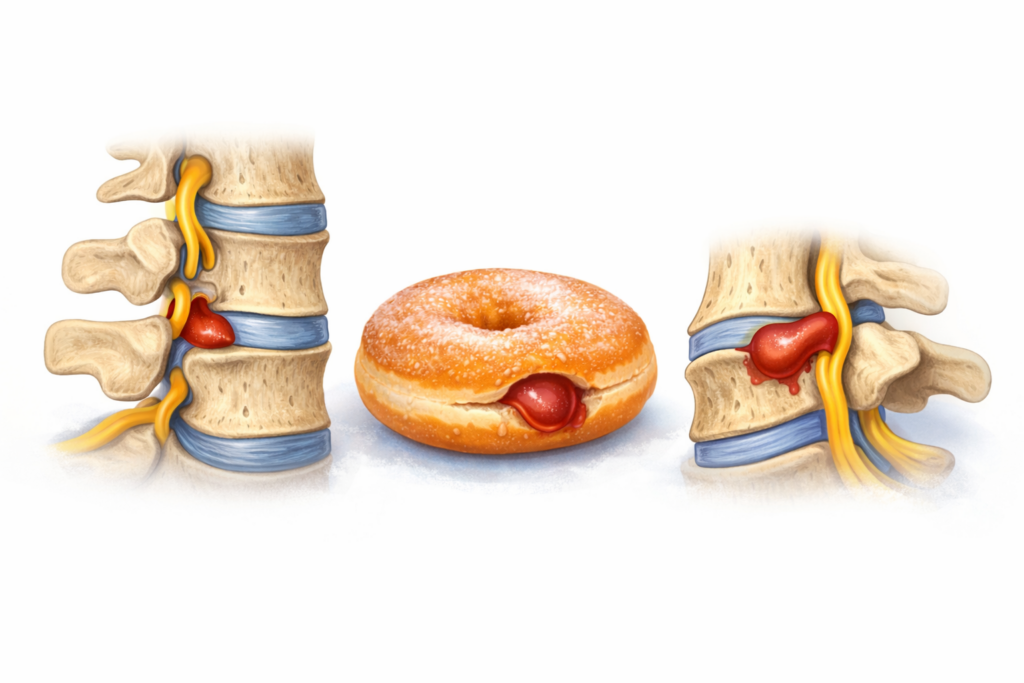
The outer ring of the disc is like the dough of the donut. It’s strong, layered, and meant to hold everything together. The center of the disc is the jelly—soft, squishy, and designed to move slightly as you move.
When the donut is new and fresh, the dough is thick and resilient. The jelly stays neatly in the middle. This is what a healthy disc looks like.
But over time, things change.
How a Disc Herniates
A disc herniation happens when pressure inside the disc pushes the “jelly” toward the outer edge. If the outer layer weakens or develops small tears, the jelly can bulge outward—or, in some cases, push through.
Think about squeezing a jelly donut from one side. The jelly doesn’t disappear—it moves. If the dough is strong, nothing dramatic happens. If the dough is thin or cracked, the jelly starts to ooze out.
That’s a disc herniation.
This is why herniations often develop gradually rather than from one single event. Repeated bending, twisting, prolonged sitting, heavy lifting, or poor movement habits all increase pressure inside the disc. Over time, the outer “dough” can weaken.
Add in age-related changes (discs naturally lose hydration as we get older), and the donut becomes easier to deform.
Why It Can Hurt—Or Sometimes Not
Here’s an important—and often surprising—fact: not all disc herniations cause pain.
The disc itself doesn’t always hurt. Pain usually occurs when the bulging jelly irritates a nearby nerve. That’s when symptoms can travel into the buttock, leg, or foot, sometimes with tingling or numbness.
Other times, a disc bulge is found on imaging and causes no symptoms at all. This is why scans need to be interpreted carefully and always alongside a physical exam.
Why Backs Feel Better Some Days and Worse Others
People with disc-related pain often say their symptoms fluctuate. That makes sense when you think like a donut.
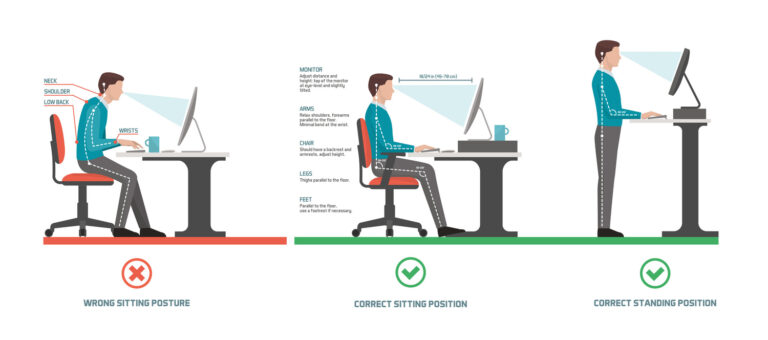
Certain positions—like prolonged sitting or slouching—push the jelly backward, increasing pressure on sensitive structures. Other positions—like standing, walking, or gentle extension—can reduce that pressure.
That’s also why people often wake up stiff, feel worse after sitting, and better after moving.
The Good News
Discs are remarkably resilient. The body can reabsorb herniated material over time, and the outer layer can regain strength with proper movement and loading.
Most disc herniations improve without surgery. Treatment focuses on:
- Reducing irritation to sensitive nerves
- Improving movement patterns
- Gradually strengthening the spine
- Teaching the disc how to tolerate load again
In other words, helping the donut hold its shape.
Understanding Reduces Fear
When people understand what’s actually happening in their spine, fear often decreases—and that alone can reduce pain.
A herniated disc doesn’t mean your back is “broken.” It means a structure designed to move and adapt has been overloaded and needs the right kind of care.
Sometimes, it’s not about avoiding movement—it’s about learning which movements help the jelly stay where it belongs.
And that’s a puzzle I never get tired of solving.