
Your hand keeps tingling.
Maybe your thumb and fingers go numb while driving. Perhaps you wake up shaking your hand in the middle of the night. Or maybe your grip just doesn’t feel as strong as it used to.
Many people immediately assume it’s carpal tunnel syndrome.
Sometimes they’re right.
But not always.
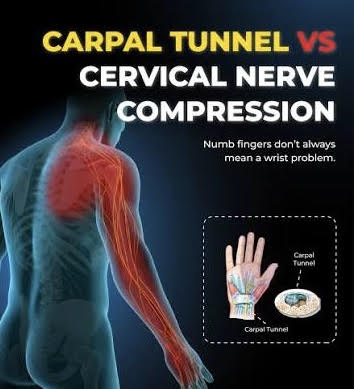
One of the most common surprises we see in physiotherapy is that symptoms in the hand can actually be coming from the neck.
What Is Carpal Tunnel Syndrome?
Carpal tunnel syndrome occurs when the median nerve becomes compressed as it travels through a narrow passageway in the wrist called the carpal tunnel.
Common symptoms include:
- Numbness or tingling in the thumb, index, middle, and part of the ring finger
- Symptoms that are worse at night
- Dropping objects more often
- Weakness with gripping or pinching
- Relief after shaking the hand
Typing, repetitive hand use, pregnancy, diabetes, arthritis, and wrist swelling can all contribute.
When the Neck Is the Real Problem
The nerves that supply your hand actually begin in your neck.
As they travel from the cervical spine, they pass through the shoulder region, down the arm, and eventually into the hand.
If one of these nerves becomes irritated or compressed in the neck, you may experience symptoms that feel remarkably similar to carpal tunnel syndrome.
This is sometimes called cervical radiculopathy.
Clues That Your Neck May Be Involved
You may notice:
- Neck pain or stiffness
- Pain travelling into the shoulder or arm
- Tingling involving the entire arm, not just the hand
- Symptoms that change when you move your neck
- Weakness in the shoulder, arm, or hand
- Relief when changing your neck position
Of course, these aren’t hard-and-fast rules. Some people have very little neck pain, even when the neck is the source of their symptoms.
Could It Be Both?
Absolutely.
Some people have irritation of the nerve in the neck and compression at the wrist.
This is sometimes referred to as a “double crush” phenomenon, where the nerve is more sensitive because it’s being irritated in more than one location.
That’s one reason a careful assessment is so important.
How Can Physiotherapy Help?
At Spine & Sports Physiotherapy, we don’t just examine the hand.
We assess the entire pathway of the nerve, including:
- Neck mobility
- Shoulder movement
- Nerve tension
- Wrist mobility
- Muscle strength
- Sensation and reflexes
- Everyday activities that may be contributing to your symptoms
Treatment depends on the source of the problem and may include manual therapy, nerve gliding exercises, posture correction, strengthening, ergonomic advice, and activity modification.
If your symptoms suggest true carpal tunnel syndrome, we may also recommend wrist splinting or discuss whether further medical investigations are appropriate.
Don’t Guess
The biggest mistake we see is treating the wrong area.
Massaging the wrist won’t help much if the nerve is irritated in the neck. Likewise, stretching your neck won’t solve compression at the wrist.
Finding the source of the problem is the key to successful treatment.
The Bottom Line
Numbness and tingling in the hand don’t automatically mean you have carpal tunnel syndrome.
Sometimes the wrist is responsible.
Sometimes the neck is the culprit.
Sometimes it’s a combination of both.
The good news is that a thorough physiotherapy assessment can usually identify where the problem is coming from and help guide the most effective treatment—so you can get back to sleeping, working, driving, and living without constantly wondering why your hand won’t behave.